
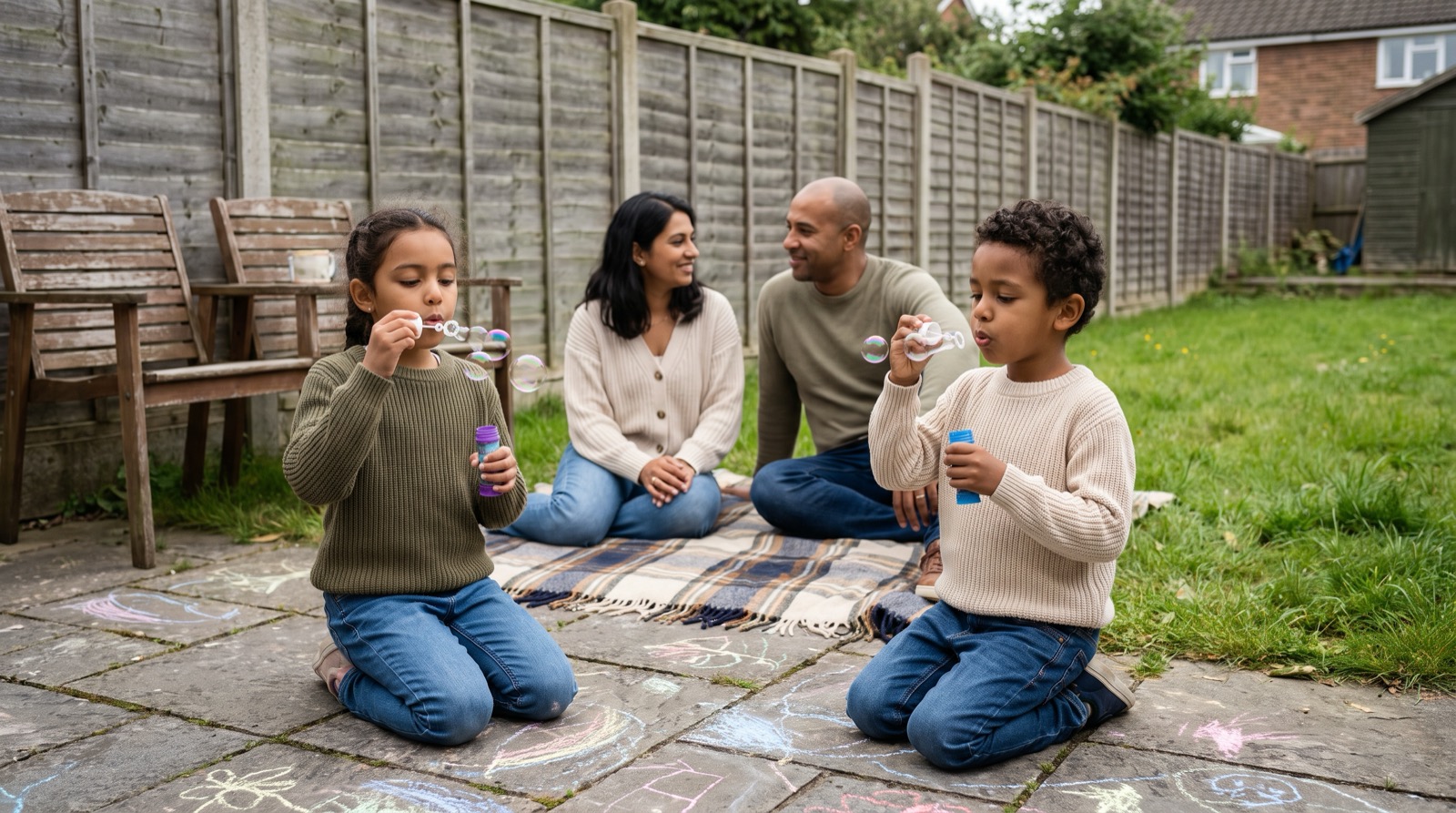
Summer holidays do not have to be overwhelming. With the right scaffolding, they can be genuinely enjoyable for the whole family.
UK school holidays are roughly six weeks long. For many neurodivergent families, that stretch of unstructured time is harder than term time, not easier. Routines dissolve, sleep drifts, and the activities that felt manageable in May feel enormous in July. This guide is for parents and carers of neurodivergent children who want a calmer summer without losing the looseness the season is for.
Key takeaways
- The six-week summer holiday is often harder for neurodivergent children than term time because the daily scaffolding of school disappears overnight.
- Structure and rigidity are different things; visible, predictable "anchor points" in the day help without turning summer into a timetable.
- Sensory-friendly does not mean sedentary. Matching activities to your child's sensory profile, and timing outings around quieter hours, may help reduce the chance of overload for some children.
- One big activity a day, with genuine rest built around it, tends to work better than a fully packed schedule.
- For many children, screen time can act as a regulation tool rather than a failure of the day's plan. Shared agreements about screens work better over six weeks than blanket restriction.
Why holidays land harder for neurodivergent families
Term time carries its own scaffolding. School starts at the same time every morning. Lunch is at the same time every day. The adults in the building are largely predictable. During the holidays, that scaffolding disappears overnight.
For neurodivergent children, the loss of structure is not just inconvenient. It is often dysregulating. Many parents and clinicians describe predictability as easier for neurodivergent children to manage, while unexpected changes, even welcome ones, can take more energy to process. Long unstructured days produce what many parents describe as a slow build-up of edge: more arguments, more tears, more screen-time battles, more shutdowns, fewer smiles.
That build-up does not mean anything is going wrong. It means the system is missing its supports. The goal of the holidays is not to recreate school. It is to build a softer version of structure that lets your child rest, recover, and try new things without being overwhelmed.
You are not failing at summer. You are trying to meet a real challenge without a manual.
Building structure without rigidity
Structure and rigidity are not the same thing. Structure is knowing what tends to happen when. Rigidity is refusing to deviate from a fixed plan. Neurodivergent children usually cope best with structure that has visible, predictable contours but leaves room for the day to flex.
A practical approach many UK families find useful is the "anchor points" model. Pick three or four anchor points in the day: wake-up, morning activity, lunch, afternoon activity, dinner, wind-down. They do not need exact times. They do need consistent order. A simple visual chart on the kitchen wall, with Velcro-backed pictures your child can move as each anchor point passes, gives a visible shape to the day without turning it into a timetable.
Build in a "do nothing" anchor too. Every child, and every adult, needs genuine downtime. Treat it as part of the plan, not a failure of the plan.
When a day goes off-script, and days will, do not treat it as broken. Treat it as a data point. What was hard? What would have helped? Adjust tomorrow's anchors and move on.
Sensory-friendly activities
Many neurodivergent children find the high-sensory environments of typical summer days difficult. Bright sun, hot temperatures, crowded parks, festival-style events, and unstructured play with lots of unknown children may add to the load on a sensory system that's already working hard.
Sensory-friendly does not mean sedentary or solitary. It means matched to your child's sensory profile.
Some UK summer activities that many families find manageable:
- Early-morning or late-afternoon trips to National Trust gardens and parks, when crowds are thinner and heat is lower.
- Woodland walks with underfoot variety, such as Forestry England sites, which some families and occupational therapists suggest may offer helpful sensory input through uneven ground.
- Beach trips with planned shade, a cool tent or pop-up shelter, and a bucket of cold water for cooling feet and hands.
- Soft play centres in the morning, when most are quieter and less stimulating.
- A planned "low-demand" day at home each week, where no outings are scheduled and recovery is the goal.
- Library visits and story-time sessions, which often air-condition well and are short.
- Local lidos and outdoor swimming in the early morning, when chlorine and crowds are both lower.
Plan one big activity a day at most. Build the rest around rest. The most regulated children are usually the ones who do not have every hour filled.
Managing screen time
Screens are not the enemy. For many neurodivergent children, a tablet can be a regulated activity, a way to recover from overstimulation, and a tool that helps get the family through difficult moments. Treating all screen time as a problem usually produces more conflict, not less.
That said, holidays do drift. The two hours that were the limit in term time often become five or six before anyone notices. A better approach than total restriction is shared agreement.
Some approaches UK families have found useful:
- Co-watch when you can. Some families find that watching together turns screen time into connection time and makes it easier to notice early signs your child may be finding things harder.
- Time-bank the screen time. Earn screen time through non-screen activities, or front-load the morning with screens if the afternoon has a sensory-heavy outing planned, so the tablet is not competing with an activity that needs your child's energy.
- Agree the ending in advance, not in the moment. Many families find that a warning at "two more episodes" or a visual timer works better than a sudden stop, as it may give your child more time to prepare for the change rather than being pulled out of it without notice.
- Keep one or two screen-free anchors, such as mealtimes or the last half hour before bed, so the day still has some non-negotiable shape around screens without banning them outright.
None of this needs to be perfect. Some days the plan will slip and the screen time will run long, and that is fine. What matters over six weeks is the general pattern, not any single afternoon. A rough shared agreement that you can adjust as you go will serve your family better than a strict rule that gets broken and abandoned by the second week.
Self-care for parents
Six weeks is a long time to be the primary source of structure, entertainment, and regulation for another person, especially when that person is having a harder time than usual. It is worth naming plainly: parents and carers of neurodivergent children run on less slack during the holidays, and that is not a personal failing, it is just the maths of the situation.
Protecting your own energy is not indulgent, it is part of what makes the rest of the plan work. If you have family nearby, a partner who can take a shift, or a trusted friend, build in your own anchor points too, even a short walk alone or twenty minutes with a cup of tea that is still warm when you drink it. Some councils and local carers' organisations run short-notice respite or holiday activity schemes for disabled children, and it is worth checking what is available in your area well before the summer starts, since spaces often fill early.
It also helps to lower the bar on what "a good day" looks like. A day where nobody is at their best but everyone gets through it calmly is a good day. You do not need to fill six weeks with outings, crafts, and memories to be doing this well. Getting your child, and yourself, to September in one piece, a little more rested and a little better understood, is enough.
Frequently asked questions
Do all neurodivergent children struggle with the summer holidays? Not all, but many find the loss of routine harder than term time itself. The degree varies widely between children and even between years for the same child, depending on sleep, growth spurts, and what else is going on in family life.
How much structure should we aim for each day? Most families do well with three or four loose anchor points rather than a full timetable. The goal is predictable shape, not a rigid schedule, so there is still room for rest and spontaneity.
Is it bad for my child to have more screen time in the holidays than during term time? An increase during the holidays is normal and not automatically harmful. What tends to help most is having a shared, flexible agreement about screens rather than either no limit at all or a strict rule that causes daily conflict.
What if my child refuses every activity we plan? Refusal can sometimes be a sign of overload or low predictability, though there are many possible reasons, a professional who knows your child is best placed to say what's going on for them specifically. Offering fewer choices, previewing what will happen with pictures or simple words, and building in an easy exit if it goes wrong can make activities feel safer to attempt.
Are there funded holiday activities for disabled children in the UK? Some local authorities and charities run holiday activity and food (HAF) programmes and short-break schemes with places for disabled children, though availability varies by area. Contact your local council's SEND team or a local carers' organisation to find out what is on offer near you.
When should I seek professional support rather than just managing at home? If your child's distress, sleep, or eating is seriously affected for more than a few weeks, or if you as a parent are struggling to cope, it is worth speaking to your GP or health visitor. For any urgent health or safety concern, contact NHS 111 or emergency services as appropriate.
Sources and references
- NHS.uk (2024). Autism and school holidays: tips for parents and carers. https://www.nhs.uk/conditions/autism/autism-and-everyday-life/help-for-families/
- National Autistic Society (2023). Managing changes and unstructured time. https://www.autism.org.uk/advice-and-guidance/about-autism/preference-for-order-predictability-or-routine
- ADHD Foundation (2024). Supporting children with ADHD during the school holidays. https://www.adhdfoundation.org.uk/
- Contact (2023). Short breaks and holiday activities for families with disabled children. https://contact.org.uk/help-for-families/information-advice-services/social-care/play-leisure-and-recreation/
- Council for Disabled Children (2024). Holiday activities and food (HAF) programme guidance. https://councilfordisabledchildren.org.uk/resources/all-resources/filter/inclusion-send/holiday-activities-and-food-programme-toolkit
- Carers UK (2023). Looking after yourself as a parent carer. https://www.carersuk.org/help-and-advice/your-health-and-wellbeing/looking-after-yourself/
- Scope (2024). Sensory-friendly days out: a guide for families. https://www.scope.org.uk/advice-and-support/days-out-disabled-kids
Disclaimer
This article is written and published by NeuroCheck Pro as general information for parents and carers. It is not a medical assessment or diagnosis and should not be used to replace advice from a qualified health professional. If you have concerns about your child's health or development, please speak to your GP, health visitor, or another appropriate professional, and for any urgent health concern, contact NHS 111. If you are struggling and need to talk to someone, Samaritans are available free, any time, on 116 123.